
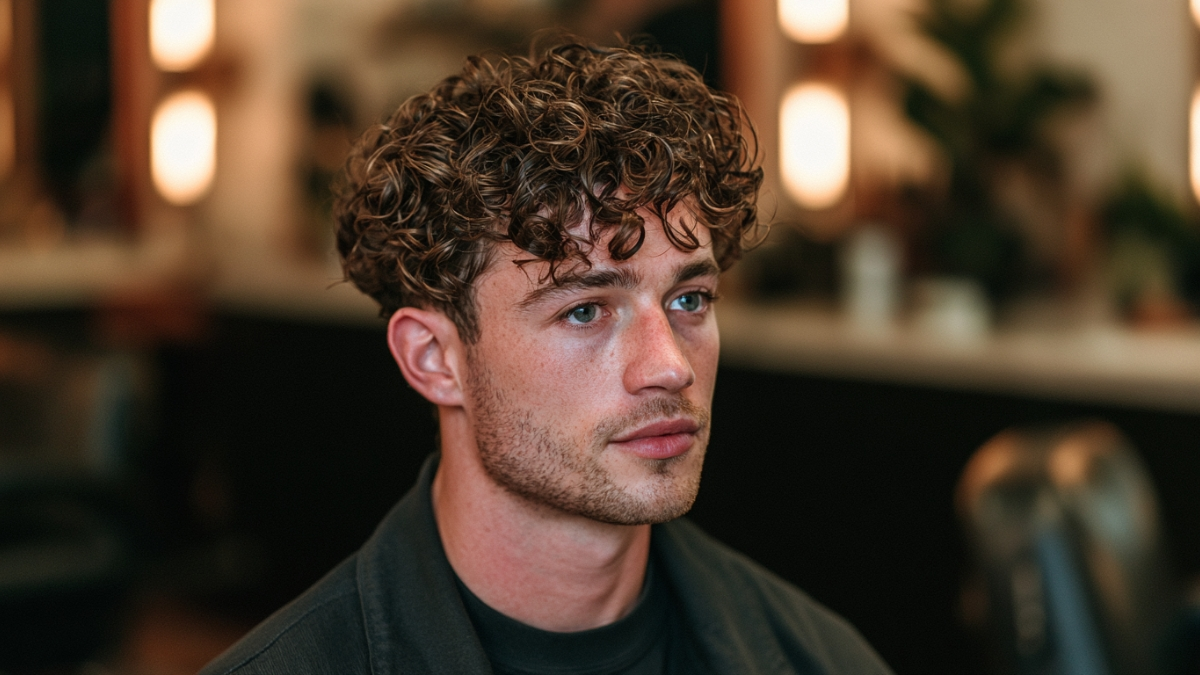
Curly haircuts for men can go in completely different directions depending on how much length you keep and what your natural curl wants to do.
Some cuts rely on tight fades and shorter sides, while others work better when you leave more length and let the curls carry the shape.
The styles below are the ones I’d actually compare before deciding what makes sense for your hair.

In this article
34 Curly Haircuts for Men
These curly haircuts for men show how much the result can change depending on the length you keep, how short the sides go and how much of your natural curl stays visible.
Curly Undercut

A curly undercut keeps the sides very short while leaving much more length on top.
There’s very little transition between the two, so the curls stand out immediately. That works best when you have enough density on top to stop the haircut feeling empty around the sides.
I like this if you want the separation to be obvious. It’s less subtle than a fade, and that’s the reason to choose it.
Textured Curly Crew Cut

A textured curly crew cut keeps the top short, but not so short that the curl pattern disappears.
You still get visible texture through the top, while the sides stay shorter and easier to manage.
For me, this is one of the better short curly cuts because it still looks like curly hair. Take too much off the top and you lose the very thing that makes the style worth choosing.
Tapered Curls

Tapered curls keep most of the natural fullness while taking the temples and neckline shorter.
The advantage is that you keep the width and density through the sides instead of stripping everything down into a full fade.
I like this especially on thicker hair. It gives the haircut some shape around the edges without taking away the fullness that makes the curls look good.
Curly Skin Fade

A curly skin fade takes the shortest part of the sides right down to bare skin.
That makes the curls above look much more noticeable, especially when the top has enough thickness or length to stand on its own.
I’d be more selective with this one. It exposes more of your temples, hairline and head shape, and the contrast starts changing quickly once the sides grow back.
If you like a very short fade and don’t mind keeping it fresh, it can work extremely well.
Curly Buzz Cut With High Fade

A curly buzz cut with a high fade keeps the top very short while taking the sides much tighter and higher around the head.
You still get some visible curl through the top if your pattern is tight enough, but the high fade adds much more contrast than a standard buzz cut and puts more attention on the shape of the head.
I’d choose this if you want something very short but still want the fade to make a noticeable difference. Just keep in mind that your temples, hairline and head shape are much more exposed once the sides are taken that high.
Curly Hair with High Fade

A high fade takes the sides much shorter and starts the fade well above the temples.
That leaves the curls concentrated on top and creates a much stronger difference between the top and sides.
You don’t need long curls for this to work, but you do need enough definition for the top to hold its own. If your curls are very short or fine, taking the sides this high can make the haircut feel too severe.
I like this when you want the fade to make a real difference to the overall shape.
Messy Curly Hair Fade

A messy curly hair fade pairs shorter faded sides with longer curls on top that are allowed to move and fall naturally.
This works best when your curl pattern already has some natural movement. The top should look loose rather than carefully placed, so you don’t need every curl pointing in the same direction.
The mistake I’d avoid is using too much product. Once the curls start looking stiff, the whole point of this cut is gone.
Modern Curly Mullet

A modern curly mullet keeps more length through the back while the sides are taken much shorter.
Curly hair works well with this shape because the texture gives the back more body and stops it looking flat. The extra length behind the ears is a big part of the haircut, not just a small detail.
I’d only choose this if you actually like that longer back. As it grows, the mullet shape becomes more obvious rather than less.
Curly Burst Fade

A curly burst fade keeps the shortest area around the ear while leaving more hair toward the back.
That gives it a very different profile from a standard fade, especially when the curls continue behind the ear instead of being taken short all the way around.
I like this when you want the fade itself to be more noticeable. Cut the back too short and the burst fade starts looking like a plain high fade instead.
Crop Curls

Crop curls keep the top fairly short and bring more of the shape toward the front.
You still get visible curl, but the haircut stays compact and easier to manage than longer curly styles. Tighter curls usually suit this especially well because the texture still shows at shorter lengths.
For me, the key is leaving enough hair at the front for the curl to form. Take it too short and it starts moving closer to a crew cut.
Curly Pompadour

A curly pompadour keeps more length through the front and pushes the hair upward and back.
This works best when your curls have enough density and length to hold some height. It can look great, but it needs more control than a crop or messy curly style.
For me, this only makes sense if you’re happy spending extra time on the front. Humidity and movement through the day can change the shape quickly.
Curly Mohawk

A curly mohawk keeps a strip of longer hair through the center while the sides are taken much shorter.
The curls give the middle more fullness and stop the shape from looking too rigid. You still need enough length on top, though, or it can start looking more like a high fade with a narrow center.
I’d only go for this if a much more noticeable haircut is what you want. The strong difference between the center and sides is the whole point.
Curly High Taper

A curly high taper takes the shorter temple area farther up while still keeping plenty of hair through the sides and back.
That gives the front a tighter look without stripping the whole side down like a full high fade. You still keep enough width for the curls to feel connected around the head.
I like this when a regular taper feels too subtle but you don’t want the stronger break of a high fade. It works especially well when your curls are thick enough to keep some shape through the sides.
High Skin Fade With Curly Hair

A high skin fade takes the sides right down to skin and starts the transition high above the temples.
That leaves almost all the visual weight on the curls above it, so the top needs enough definition to make that much separation work.
I’d be careful with this if your hairline is already moving back or your curls are very short. Going this high leaves almost nothing behind to soften either problem.
Long Brushed Back Curls

Long brushed back curls use the extra length to sweep the curls back from the forehead without flattening their natural texture.
This works best when your curls are loose enough to move backward without constantly springing forward again. You need enough length for the front to stay back without pulling everything flat.
I like the result, but it asks more from the hair than it first appears. If your curls naturally fall forward, you may spend more time resetting the front than you expected.
Messy Curls (The Lazy Option)

Messy curls work best when your natural pattern already gives the hair some shape without much help.
You keep enough length for the curls to form, add a small amount of product if needed, and let the top fall differently from day to day rather than trying to place every curl.
For me, the whole point is keeping the effort low. If you’re spending 20 minutes separating sections and forcing the hair into a messy finish, you’ve missed what makes this option appealing.
Curly Quiff

A curly quiff keeps more length through the front and lifts the hair upward instead of letting it fall across the forehead.
The curls give the front extra texture, but you still need enough length and density to create height without the shape collapsing too quickly.
I’d choose this if you like showing more of your forehead and don’t mind doing some work at the front. If your hair naturally wants to fall forward, a fringe or crop will usually ask much less from you.
Thick Curly Hair With Low Fade

Thick curls with a low fade keep most of the natural density while only taking the hair much shorter near the ears and neckline.
Thick hair can carry that extra weight at the sides without the cut looking bulky, which is exactly why this pairing works.
I’d usually keep the fade low here. Taking it higher can remove more of the natural shape than you actually need.
Brushed Back Curls

Brushed back curls lift the hair off the forehead, but with less length and height than the longer brushed-back version.
That makes this easier to manage if you like the look of hair pushed back but don’t want to grow it out too far. You still keep visible curl through the top instead of forcing everything flat.
I like this when you want a more controlled shape without turning it into a quiff or pompadour. It works best when the curls can move backward without needing constant restyling.
Textured Short Curls With Fade

Textured short curls with a fade keep enough length on top for the curl pattern to stay obvious while taking some of the weight away from the sides.
That makes it a useful option if you want short hair but still want the texture to be one of the first things you notice.
I’d keep more length than you think through the top. Cut it too close and the curl disappears, leaving you with a much more ordinary short fade.
Curly Perm (Proceed With Caution)

A curly perm can add curl to naturally straight or slightly wavy hair, but I wouldn’t treat it like a quick way to copy every curly haircut in this list.
The result depends heavily on your starting hair, the size and tightness of the curl, and how the hair reacts afterward.
I’d only go down this route if you actually want the commitment. The texture can feel very different from natural curls, and most perms need refreshing every three to four months once new, untreated hair starts showing at the roots.
Heavy Curly Fringe With Taper Fade

A heavy curly fringe keeps much more length through the front while the taper shortens the temples and neckline.
That makes the fringe the main feature, with the curls falling lower over the forehead instead of being pushed back or lifted.
I like this if you want more coverage at the front and don’t mind the extra weight there. The taper suits it well because you keep enough hair through the sides for the fringe to feel connected to the rest of the haircut.
Short Tousled Curls

Short tousled curls keep enough length for the curls to move without letting the top get too long.
The difference between this and a more controlled short cut is that the top shouldn’t look carefully arranged. A little unevenness through the curls is part of the look.
I like this when you want short hair without losing all the movement. Go too heavy with product and that loose finish disappears quickly.
Messy Curly Shag

A messy curly shag keeps more length through the sides and back, with shorter layers creating a rougher, less uniform shape.
That gives the haircut a looser finish than a fade or taper and works best when your curls already have some natural volume.
I like this if you want the hair to look less controlled and a little more uneven. Once it grows too far past the intended shape, though, the shag can start looking bulky rather than relaxed.
Shoulder-Length Curly Layers

Shoulder-length curly layers keep enough length for the curls to fully form while breaking up some of the weight through the hair.
The layers help stop everything falling into one heavy shape and give the curls more room to fall naturally around the shoulders.
For me, the key is leaving enough length in the layers. Curly hair can spring up more than you’d expect, so if you’re unsure, leave a little extra as a buffer.
Textured Surfer Curls

Textured surfer curls keep the hair longer and looser, with the natural curl pattern doing most of the work.
This looks best when your hair already has some wave or relaxed curl, because the shape should feel easy rather than heavily styled.
I like this if you’re happy with the hair changing a little from day to day. If you want every section staying in the same place, I’d look at something more controlled.
Long Curly Shag

A long curly shag keeps plenty of length through the sides and back while using layers to stop all that hair dropping into one heavy mass.
The idea is to keep the length but give the curls enough separation to show properly through the whole haircut.
I’d choose this if you want long hair without losing the shape of the curls. It needs more drying time, and once the layers grow out too far, the hair can start feeling heavy again.
Long Curly Hair With Middle Part

Long curly hair with a middle part splits the hair away from the center and lets the curls fall down either side of the face.
This works best when you have enough length for the curls to drop rather than springing straight back toward the middle.
I like this most on looser curls or waves. Tighter curls can still work with a middle part, but you usually need more length before the part becomes obvious.
Curly Tousled Fringe

The tousled fringe keeps more length through the front and lets the curls fall forward without forcing them into one exact shape.
That works well if your hair naturally wants to come toward the forehead rather than being pushed back. You still get plenty of texture at the front without needing every curl to fall perfectly.
I like this when you want the fringe to look loose rather than heavy. If too much hair starts bunching together across the forehead, the front can quickly lose that lighter, broken-up shape.
Curly Man Bun

A curly man bun needs enough length through the top, sides and back for the hair to pull back without too much tension.
The curls give the bun more texture and volume, but you still need enough length for the shorter sections to reach comfortably.
I’d only go for this once the hair is actually long enough. Trying to tie shorter curls back usually means pulling too tightly or leaving too much hair falling out around the sides.
Frosted Curly Top With Burst Fade

This combines a burst fade with lighter color through the curls on top.
The burst fade keeps the shortest area around the ear, which gives the haircut a more rounded shape through the sides and back. The lighter ends then draw even more attention to the curl pattern on top.
I like this when the color brings out the texture instead of becoming the main thing you notice. If the contrast between the darker roots and lighter curls gets too strong, the color can start overpowering the haircut itself.
Medium Messy Curls

Medium messy curls land in a useful middle ground where the curl pattern has enough length to open up without becoming a long style.
You get noticeably more shape and movement than you would from a short crop, but drying and styling are still much easier than they are with shoulder-length curls.
For me, this is one of the better choices if you want fuller curls without taking on the extra work that comes with long hair.
Long Natural Curls

Long natural curls aren’t just about letting the hair keep growing. The shape still matters once you have that much length.
You want enough weight for the curls to drop properly, but not so much that everything starts hanging in one heavy mass. A little structure through the length helps the curl pattern stay visible from top to bottom.
I like this when the natural curl already does most of the work. The aim is to keep the length looking healthy and shaped rather than trying to make every curl look identical.
Curly Flow With Full Beard

Curly flow with a full beard puts a lot of hair around the face, so the proportions matter.
The curls need enough length to move back and away from the forehead, while the beard adds more weight through the lower half of the face.
I like this combination when neither the hair nor the beard overwhelms the other. The main thing I’d watch is too much width through the sides, because that can make the whole look feel heavier than you wanted.
Start With How Much Length You Actually Want
The easiest way to narrow down these curly haircuts is to decide how much length you actually want to keep before thinking about the finer details.
If you want short hair, a crew cut, crop, buzz cut or short faded style makes more sense. You still get some curl showing, but you’re giving up a lot of movement in return for easier day-to-day upkeep.
Medium length gives you more room. Your curls can open up properly, you can push them back, let them fall forward or keep them loose without dealing with the drying time that comes with longer hair.
Long curls give you the most movement and the most visible curl pattern, but they also ask more from you. Washing takes longer, drying takes longer, and once the shape starts getting too heavy, the haircut needs more than just a quick trim around the sides.
For me, this is the first decision to make. A lot of curly haircuts for men look great in photos, but if you don’t actually want that much length on your head, the rest of the style is irrelevant.
Some Curly Haircuts For Men Need Your Natural Texture More Than Others
Your natural curl pattern makes some of these styles much easier than others.
Loose curls and waves usually suit surfer curls, brushed-back styles and shags because the hair already has the movement those cuts need. If your hair naturally falls forward, a fringe or crop usually makes more sense than trying to push everything back.
Tighter curls can hold their shape well at shorter lengths, which is why crew cuts, crops and shorter faded styles can still show plenty of texture without needing much length.
I’d pay attention to both the curl pattern and the direction your hair naturally falls. A haircut becomes much easier when the shape already makes sense for what your curls want to do.
Your Hairline and Face Shape Can Narrow the List Fast
Your curl pattern matters, but so does what the haircut exposes around your face.
If your temples are starting to move back, a high skin fade, buzz cut or brushed-back style will usually make that easier to see. A heavier fringe, lower fade or more length around the front gives you more coverage.
Face shape matters too, but I’d pay more attention to where the haircut adds or removes width than to following a strict face-shape rule. Very short sides can make a wider face look narrower, while a lot of height on top can make a longer face look even longer.
Curly hair adds another variable because the volume can pile up high, wide or both. I’d look at where your curls naturally build up before choosing how short to take the sides.
I wouldn’t choose a haircut from the front view alone. Check what it does from the side, how much forehead it shows and where the curls add width around your head.
That usually cuts the list down quickly and gives you a much better idea of which styles are actually worth considering.
The Haircuts I’d Choose If You Want Less Work
If you don’t want to spend much time on your hair every morning, I’d narrow the list down pretty quickly.
The textured curly crew cut, crop curls and textured short curls with a fade are strong starting points because there’s less hair to dry and less shaping needed before you leave the house.
Tapered curls and thick curls with a low fade are good alternatives if you want to keep more length. They don’t depend on getting the top into one exact position, which makes them much easier on mornings when you don’t want to spend ages on your hair.
The cuts I’d avoid if low effort is the priority are the curly pompadour, quiff, long brushed-back curls and man bun. They either take longer to dry, need more control through the front or depend on having enough length to keep the shape working.
For me, low effort is less about choosing the shortest haircut and more about removing unnecessary steps from your morning routine.
Beard Beasts Verdict
There are 36 curly haircuts here, but you don’t need to make the decision complicated.
Start by cutting out anything that needs more length, styling or hairline exposure than you actually want. Once you do that, the list gets much shorter.
For most people, I’d rather see a simpler cut that lets the curls look good consistently than a more dramatic style that only works when everything goes perfectly.
That’s what I’d judge the haircut on. If you still like it after the first-day finish is gone, the sides have grown a little and the curls are doing their own thing again, you made the right choice.