
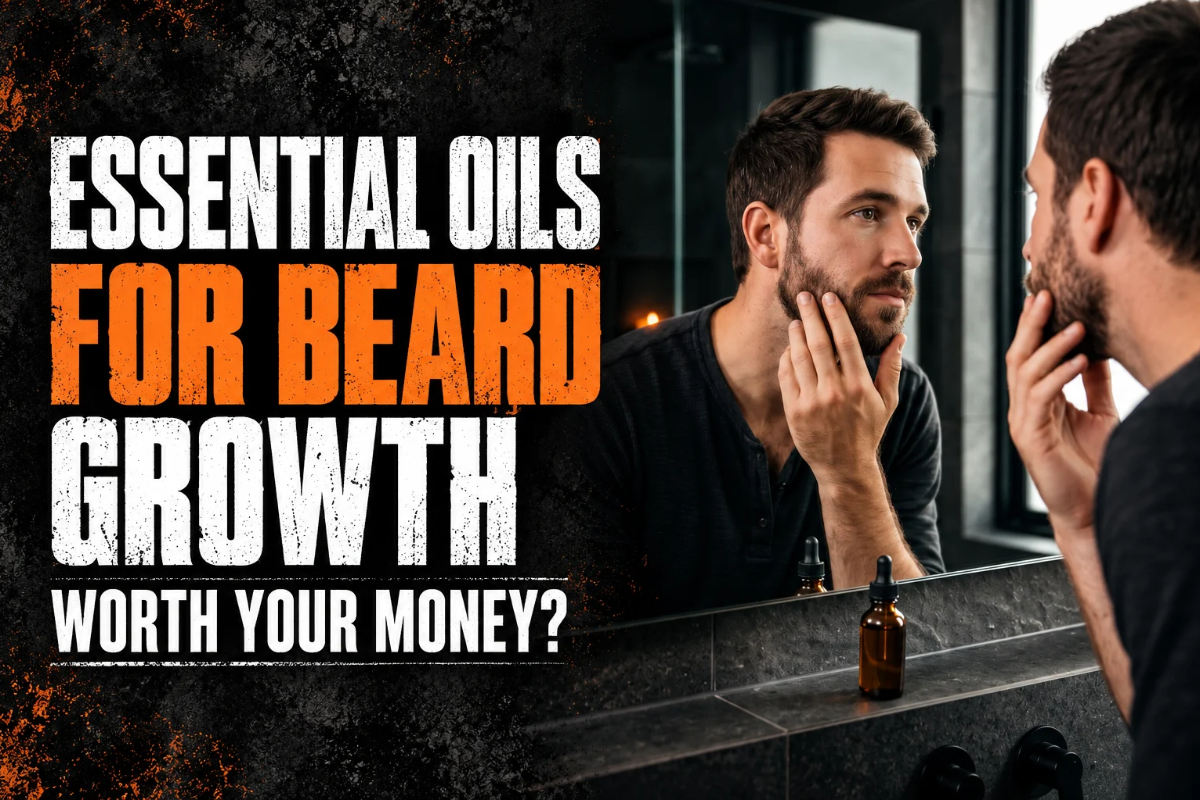
If you’ve got a patchy beard, it’s tempting to try a bottle of rosemary or peppermint oil and see what happens. They’re easy to find, and when you’re hoping those gaps will fill in, even a small chance of success can sound worth paying for.
The problem with essential oils for beard growth is that the claims go further than the research. Some oils have been studied for hair growth, but mostly on scalps or animals. So far, there’s no convincing evidence that they’ll make a human beard grow thicker.
That doesn’t mean every oil is a waste of money. But before paying extra for something that promises new growth, I’d want to know which oils have some research behind them, what they can realistically do, and whether they’re actually worth buying.

In this article
Can Essential Oils Really Make Your Beard Grow Thicker?
A beard can look thicker without actually growing any more hair. That’s where some of the confusion comes from. You might want to fill in the gaps on your cheeks, while someone else just wants the facial hair he’s already got to look fuller. Those are two different things.

A regular beard oil can soften coarse facial hair, make it easier to manage, and help with dry skin underneath. Most of that conditioning comes from carrier oils such as jojoba and argan. So if a product containing rosemary leaves your beard feeling softer, there’s a good chance the carrier oils are doing much of the work.
How much you apply matters, too. A little oil can help rough, unruly hairs look tidier, but too much can make fine or sparse facial hair stick together and lie flatter. That can actually make the gaps in your beard more noticeable. Sometimes the way you groom your beard makes more of a visible difference than the ingredients you’re putting in it.
You’ll usually notice a conditioning effect pretty quickly. Your beard might feel softer or look fuller within minutes of applying beard oil, but new facial hair doesn’t appear that fast. Even letting your existing beard grow longer can help cover more skin without increasing the number of hairs.
If an oil really made your beard grow thicker, we’d want to see more hairs filling in thin areas or existing fine hairs becoming thicker over time. That’s what a proper beard-growth study would need to show. How your beard feels after applying oil doesn’t tell us whether either is happening.
Rosemary Oil vs. Peppermint Oil for Beard Growth
There’s a reason rosemary gets more attention than most other essential oils.

In a 2015 study, 100 people with pattern hair loss used either rosemary oil or 2% minoxidil on their scalps for six months. Neither group showed a significant increase in hair count after three months, but both had higher counts by the end.
You might see those results described as rosemary working just as well as minoxidil. I’d be careful with that claim. The study didn’t include a placebo group, so we can’t be certain how much of the improvement came from rosemary itself. Researchers also found no clear difference between the treatments, but that doesn’t prove they’re equally effective. And they were treating scalp hair loss, not trying to grow beards.
Peppermint oil has a different story behind it. The study that gets mentioned most often was carried out on mice in 2014. Researchers applied 3% peppermint oil to their shaved backs for four weeks, comparing it with saline, jojoba oil, and 3% minoxidil. The mice given peppermint oil grew more hair, and researchers found changes in the hair follicles themselves.
There’s been some human research since then. A 2025 study involving 60 women compared peppermint oil mixed with coconut oil against coconut oil alone for scalp hair loss. Both groups massaged their scalps, and although some measurements improved, there wasn’t a significant difference between the groups overall.
Then there’s the circulation claim. Peppermint contains menthol, which can make your skin feel cool or tingly. People sometimes take that sensation as a sign the oil is working, but feeling something on your skin doesn’t mean more beard hair is growing. Even if it changes blood flow, we’d still need to see whether that makes any difference to facial hair growth.
Given the choice, I’d lean toward rosemary. At least there’s a human study suggesting it might help with certain types of scalp hair loss. Peppermint has some early findings, but they wouldn’t convince me to buy it for beard growth. I wouldn’t expect rosemary to fill in my cheeks either, although it’s the one I’d be more curious about.
What About Lavender, Cedarwood, and Tea Tree Oil?
Lavender gets recommended for beard growth, but much of the attention comes from a 2016 study involving mice. Researchers applied lavender oil mixed with jojoba to their shaved backs for four weeks. The treated mice grew more hair and showed changes in their follicles compared with control groups. That’s something worth looking at, but I’d want to see what happens in people before getting excited about lavender as a beard-growth ingredient.
Cedarwood has appeared in human research, too. A 1998 study tested a mixture of cedarwood, lavender, rosemary, and thyme on people with alopecia areata, a condition that causes patches of hair to fall out. Around 44% of those using the mixture improved, compared with 15% using carrier oils alone.
Those numbers sound encouraging until you look at what was actually tested. Four essential oils were mixed together, so there’s no way to tell which one helped or whether several were needed. The people in the study were also dealing with an existing hair-loss condition. That’s quite different from someone whose cheeks have always been naturally sparse.
Tea tree oil is better known for its skin-related uses. A 2002 study found that a shampoo containing 5% tea tree oil helped with scalp dandruff. So there’s a reason tea tree shows up in certain dandruff shampoos. But a product you rinse off your scalp isn’t the same as an oil you leave on your face, especially since tea tree can cause irritation or allergic reactions.
I wouldn’t buy lavender or cedarwood specifically for growth. If you like the scent and your skin tolerates the finished beard oil, that’s a perfectly good reason to use one. But a long ingredient list wouldn’t persuade me to spend more money. I’d be more interested in whether the product actually makes my beard feel better.
Why Essential Oils Probably Won’t Fix a Patchy Beard
If your cheeks have always grown patchy, genetics probably has a lot to do with it. Your genes influence where facial hair grows, how thick it gets, and how it responds to hormones. Age matters too. Some guys notice their beards filling in well into their twenties, so patchy growth at 19 doesn’t mean it’ll stay that way.

Testosterone and DHT help facial hair develop, but not every follicle responds the same way. These hormones can encourage beard growth while contributing to scalp hair loss in men who are prone to it. That’s why studies involving scalp hair don’t necessarily tell us what will happen to your beard.
Take a look at the patches themselves. Some areas might have fine hairs growing through them, while others barely grow anything. Your natural growth pattern has a lot to do with how full those areas eventually become.
If you’ve always had thin cheeks, I’d be more inclined to find a beard length that works with what you’ve got than spend money trying different oils. Longer hairs can sometimes cover small gaps, but if the difference in density is obvious, keeping everything shorter and more even may look better.
Minoxidil is worth mentioning because researchers have actually tested it on facial hair. A 2016 study involving 48 men found better facial hair growth compared with a placebo. A 2026 study involving 69 transgender men receiving testosterone therapy also found improvements in beard density and hair thickness. That’s already more direct evidence than we’ve got for essential oils. Still, using minoxidil for beard growth is off-label, and side effects such as skin irritation are possible. I’d speak with a dermatologist before considering it.
Suddenly losing hair from an area that used to grow normally is another matter. New bald patches can sometimes be a sign of alopecia areata or another skin condition. Rather than trying different grooming products, I’d get a dermatologist to check what’s causing the loss.
How to Use Essential Oils on Your Beard Safely
Don’t put concentrated essential oils straight onto your face. They’re strong stuff, and even natural oils can leave your skin red, itchy, or irritated. Using more isn’t going to make your beard grow faster. You’re just increasing the chance of a bad reaction.
I’d rather buy a ready-made beard oil than start mixing concentrated ingredients myself. Carrier oils such as jojoba, argan, and sweet almond do much of the work when it comes to softening facial hair and helping with dryness. The Tisserand Institute gives a general essential oil concentration range of 0.5% to 1.2% for facial cosmetics, although some oils need lower amounts. Get the concentration wrong, and you could end up irritating your face.
It’s worth testing any new product before using it across your beard. Apply a little of the oil to a small area of skin, such as your inner arm, and watch for irritation. Some reactions take days to appear, so one quick test isn’t enough. The American Academy of Dermatology recommends testing new skin care products twice a day for seven to ten days.
Once your skin has tolerated the product, start with a small amount and work it through your facial hair and the skin underneath, keeping it away from your eyes and lips. You don’t need to drench your beard. Too much oil can leave the beard looking greasy or flat, especially when it’s naturally fine.
If your skin is already sore or itchy, I’d skip added fragrance and choose a fragrance-free beard oil instead. And if something makes your skin sting or leaves you with a rash, wash it off and stop using it. There’s no point putting up with irritated skin just to keep using a particular oil.
Final Verdict: What I’d Buy and What I’d Skip
If you’re considering essential oils for beard growth because you want a thicker beard or fuller cheeks, I wouldn’t spend money expecting that result. Rosemary is the one that interests me most because of its human scalp research, but we still don’t know whether it can make facial hair grow any better.
If I were curious enough to try it, I’d choose a properly formulated beard oil containing rosemary. It would need to be something I’d happily use for ordinary beard care, without paying extra for promises of new growth. Peppermint, lavender, cedarwood, and tea tree wouldn’t be on my shopping list specifically for growing a beard.
For most guys, the decision is simpler than comparing five essential oils. If your beard feels rough or the skin underneath gets dry, a regular beard oil makes sense. You can judge it by whether it actually helps with those problems. But when your beard already feels fine and your only goal is more hair, there’s no need to buy another bottle. Save your money rather than chase results the research hasn’t shown.