
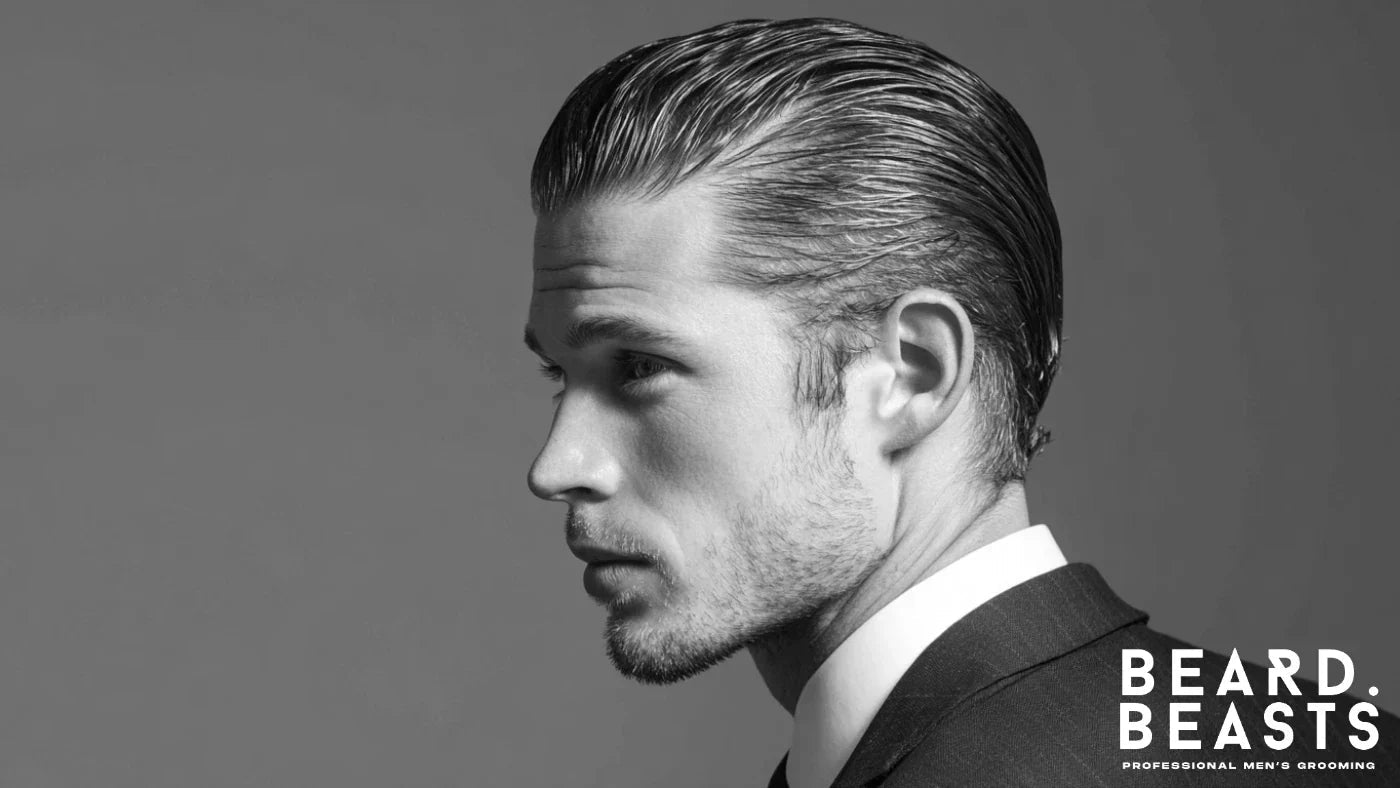
A slicked back haircut has no place to hide. Everything your hairline, your forehead, and your facial structure has to say gets said all at once. That’s either a compelling look or a mistake, depending on the face.
Get it right and it’s one of the most powerful haircuts a man can have. Get it wrong and it’s just wet hair pointing in the wrong direction.

In this article
Classic Slicked Back Haircuts
The classic versions are where you find out whether the look actually suits you, before fades and undercuts start doing extra work.
Classic Slicked Back Haircut

The original. All the hair goes back from the forehead with no parting, no fade, no tricks. Length through the top and sides, held back with a medium to high hold product, and a clean neckline at the back.
It’s the most demanding version on this list because the shape has to come entirely from the hair itself. A strong hairline and enough length to lie flat are what it needs. On the right head it’s sharp, authoritative, and completely timeless. On a receding hairline or fine hair it can look like you’re trying to cover something up rather than make a statement.
Slick Back with Side Parting

The side parting changes everything. Instead of all the hair going straight back, you part on one side and push each section back in its own direction. The result is more structured, softer on the face, and significantly more forgiving on hairlines that aren’t perfectly even.
This is probably my first recommendation for most men curious about the slick back. The parting breaks the symmetry of the face rather than putting it on full display. Oval, square, and rectangular faces all handle it well, and it plays nicely with most hair types.
Sleek Slick Back

The sleek version prioritises smoothness above everything else. No texture, no movement, no individual strands on show. The hair lies completely flat from root to tip with a high-shine product, and the finish has a lacquered quality to it.
It suits thick, straight hair. Fine hair doesn’t have enough body to hold that kind of smoothness without looking thin and plastered. If yours can carry it, the effect is precise and striking. Think boardroom rather than weekend.
Wet Look Slick Back

Similar to the sleek version but with more intentional shine, usually achieved with a water-based gel or a high-shine pomade or wax that keeps the hair looking damp. It’s a bolder finish than the sleek, leaning into the look rather than softening it.
Works best on thicker hair, and best in the evening. Under harsh daylight the wet look can tip toward looking greasy rather than intentional, which is worth knowing before you walk into a job interview with it.
Slick Back Pompadour

The pompadour version lifts the hair at the front before pushing it back, creating height at the hairline that then falls away toward the crown. It’s the most dramatic of the classic styles and the one that needs the most product to hold.
I’d point you here if you want the presence of a slicked back style without the severity of a flat finish. The volume at the front softens the overall effect and gives the face more to work with. It asks for more styling time and a stronger hold product, but the result has more personality than the standard versions.
Short Hair Slick Back

At shorter lengths the slick back becomes more of a brush back. The hair isn’t long enough to lie completely flat, so instead it sweeps back with a bit of natural lift. Less polished than the longer versions, more of an everyday look.
Honestly the version I’d point most first-timers toward before anything else. It requires less product, recovers faster when the wind or a hat gets involved, and lets you get a feel for the style without growing your hair out first.
Slicked Back Haircuts with a Fade
Adding a fade changes the dynamic of the slicked back style significantly. The sides disappear and the top has to do all the work, which intensifies everything.
Low, Mid, and High Fade Slick Back
The height of the fade is where most men get lost, and honestly it’s where I’ve seen the most disappointing results on what should have been a strong cut.

A low fade keeps the most length on the sides, starting just above the ear and graduating up from there. It’s the subtlest option and the easiest transition if you’re coming from a more conventional haircut. You get the structural benefit of shorter sides without the stark shift in contrast that higher fades produce. For a first attempt at combining a fade with a slick back, low is almost always the right call.

The mid fade starts around the temple line. The graduation is more visible, the contrast is clear, and it’s the version that photographs well without demanding the precision a skin fade requires. Most guys who ask me what fade to get with a slick back end up here, and most of them are right to. If I had to pick a default starting point, this is it.

High is where things get interesting and also where they can go wrong fast. The graduation runs almost to the crown area, leaving very little on the sides and creating a dramatic drop to the top. Wide faces should think carefully before going here. I’ve watched a high fade turn a decent slick back into something that looks like a strip of hair floating above bare scalp more times than I’d like.
On a longer or oval face with good density though, it can be exceptional. The cut earns its confidence requirement.
Slick Back Skin Fade

Taking the sides all the way down to nothing is a different category from even a high fade. There’s no graduation left, just skin meeting length. Combined with a slick back it’s the most severe version of this style and the one that asks the most from your facial features.
If the face can carry it, the cut itself becomes the statement rather than just a frame for the hair. I’ve seen it look extraordinary. I’ve also seen it look like a cry for help. Worth being brutally honest about which side you’re on before committing.
Slick Back with Drop Fade

The drop fade follows a curved line that dips lower behind the ear than at the temple, giving the fade a more natural shape around the head. It softens the overall look compared to a straight high fade at the same level, and I think it’s an underrated option that most men walk straight past. The curve does something a hard line never can.
Tapered Slick Back

A taper keeps more length through the sides, shortening incrementally from top to bottom with no defined line. Cleaner than leaving the sides natural, more conservative than any fade. This is the one for professional environments where a skin fade would look out of place.
Slick Back High Taper Fade

Combines the gradual shortening of a taper with the height of a high fade. Softer than a skin fade, higher than a standard taper. Most guys overlook it in favour of the more obvious options on either side, which is a shame because the taper looks polished without looking clinical.
Slick Back Mid Taper

Starts the graduation around the temple, blends more softly than a mid fade. Less contrast, more continuity, easier to live with as it grows out. The one I’d suggest if someone wants a polished slick back without the upkeep a fade demands.
Slick Back with Taper Design

Adding a line or shape shaved into the taper at the temple or above the enckline. Injects personality into an otherwise conventional combination. The design has a qucik life though, and once it grows out you’re either re-shaving it on schedule or watching a patchy line disappear over the next week. High commitment.
Undercut Slicked Back Hairstyles
The undercut is where the slick back gets its edge. No graduation, no blending, just a hard line where the longer top meets the shorter sides. It’s a more confrontational look than any of the fade options and the one that demands the most from the face carrying it.
Disconnected Undercut Slick Back

The disconnected slick back creates a visible break between the longer slicked back hair on top and the short sides below. The contrast is sharp and stark, and the line between the two is the point rather than something to blend away.
It’s a strong look that suits men who want something with real character. The disconnection means the top needs to be well-groomed to justify the sharpness of the sides, because everything up there is on display.
Skin Undercut Slick Back

Taking the undercut sides down to skin creates the maximum possible contrast. The top can be as long as you like, but the sides are completely bare.
This is one of those looks where the hair itself isn’t doing all the work. The face, the features, and the way someone carries themselves matter more here than in almost any other style on this list.
Textured Slick Back with Undercut

Rather than slicking the top completely smooth, the textured version pushes the hair back with a matte or low-shine product and leaves some movement and separation in the strands. The undercut underneath keeps the sides clean while the top stays more casual.
The easiest version of the undercut slick back to live with day to day. Less product, less precision, and more tolerance for the hair doing its own thing as the day goes on.
Long Slick Back Undercut with Full Beard

When the slick back undercut pairs with a full beard the balance of the face shifts. The beard fills in the lower half and gives the look weight it doesn’t have when the face is clean. The top hair going back and the beard coming forward creates a frame that works particularly well on longer faces.
The two elements have to be at a similar level of grooming or the whole thing looks unfinished. A well-kept beard with a polished slick back pulls the whole face together. A patchy beard with a sharp undercut looks like two separate decisions that never spoke to each other.
Undercut Slick Back Man Bun

At longer lengths the undercut slick back can pull the top hair into a man bun at the back, with the shaved or short sides still on show underneath. It’s a distinctive look that requires enough length on top to actually work, usually at least six inches.
The bun has to be tidy or the entire style looks messy. A loose or low bun undercuts the precision of the shaved sides and tips the look toward dishevelled rather than considered.
Textured and Curly Slicked Back Haircuts
Straight hair has dominated this style for decades but texture, waves, and curls all have versions that work, sometimes better.
Textured Slick Back

The textured slick back uses a matte or low-hold product to push the hair back while keeping the individual strands visible and separated. It’s a more relaxed interpretation of the style that suits men who want the shape without the polish.
This is the version I’d suggest to anyone who finds the high-shine styles too unforgiving or too high-maintenance for daily life. If the hair drops a little or shifts in the wind, the texture makes it look intentional rather than dishevelled, which matters more than people give it credit for.
Textured Brush Back

Similar to the textured slick back but with less product involvement. The hair is brushed back rather than styled back, keeping a natural finish that doesn’t look groomed from a distance.
For the man who wants the shape of a slick back without the commitment of the look, this is the low-effort version. A light pomade or a small amount of hair clay, a brush, and it’s done.
Messy Slick Back

The messy version accepts that the hair will move, shift, and separate throughout the day, and builds that into the look rather than fighting it. More volume, more texture, lower shine, and a looser sweep back from the forehead.
It’s the hardest version to execute intentionally because it has to look effortlessly undone rather than actually unfinished. Too much product and it looks like a failed sleek. Too little and it’s just uncombed hair. The balance is narrow.
Wavy Hair Slick Back

Wavy hair and the slick back are a natural pairing that most men with waves underuse. The movement in the hair adds dimension to the swept-back shape that straight hair simply can’t replicate, and the waves create natural separation that looks full and alive.
Salt spray on damp hair before pushing it back is usually all you need. Let the wave do the work and resist the urge to smooth it flat.
Curly Slick Back

Curls need more product and more patience to push back, but the result when it works is distinctive. The volume and coil of the curl adds something to the slick back shape that looks completely different from any of the straight-hair versions.
It helps to work with the natural growth direction rather than forcing the curls straight back from the hairline. A curl-defining cream or a strong water-based gel, applied to damp hair and pushed back gently in sections, gives the best result without flattening the curl pattern entirely.
Layered Slick Back

Adding layers into the slick back creates movement and lightness through the top that a single-length cut doesn’t have. The layers show as the hair falls and separate slightly as the day goes on, giving the look more life than a uniform length would.
Particularly useful on thicker hair that tends to feel heavy and flat when pushed back without layering. The layers let the hair move and breathe rather than lying as one solid mass.
Salt and Pepper Slick Back

Silver and grey tones at any level add texture and dimension to the slick back that younger, single-toned hair doesn’t have. The contrast between darker and lighter strands shows clearly when the hair is pushed back, and the result tends to look authoritative and considered without any extra effort.
If you’re going grey, the slick back is one of the styles that actively benefits from the colouring rather than just tolerating it. Own it.
Blonde Slick Back

Blonde hair presents differently in the slick back because it catches light in a way darker hair doesn’t. High-shine products on blonde hair can look almost transparent at the right angle, which requires a lighter application than darker hair would.
A matte or low-shine pomade tends to work better on lighter hair, keeping the texture visible and the finish looking intentional rather than saturated.
Long Slicked Back Haircuts
Longer length adds weight and movement to the slick back, and changes the maintenance requirements significantly.
Long Slicked Back Haircut

At shoulder-adjacent lengths, the hair has enough weight to stay back without the same product load that shorter lengths need. Gravity does some of the work, which can make the long slick back feel more effortless than its shorter equivalents.
The downside is that longer hair needs consistent condition and regular trims to stay healthy. Dry, split ends on a long slick back are far more visible than on shorter styles.
Long Voluminous Slick Back

The voluminous version lifts the hair at the roots before pushing it back, creating height that travels from the front through to the crown. It’s the long-hair equivalent of the pompadour version, dramatic and bold.
Thick hair handles this best. Fine hair at length often lacks the structure to hold volume at the roots without significant product support, and even then tends to collapse by midday.
Long Textured Slick Back

Texture at length means the hair is pushed back with movement and separation rather than smoothed flat. It’s the most relaxed of the long options and the easiest to live with day to day, since minor shifts and natural movement look like part of the style rather than failures of it.
Slick Back Man Bun

The man bun version gathers all the length into a bun at the back of the head, keeping the hair controlled and out of the way while maintaining the swept-back front. It’s practical as well as stylistic.
The bun placement matters. High on the crown looks clean and precise. At the nape of the neck it looks softer and more casual. Neither is wrong, but they create very different impressions and it’s worth deciding which one you’re after.
The Front Has to Carry the Haircut
Every version of the slicked back style sends the face forward, and the front of the hairline is what the eye lands on first.
A strong, even hairline makes the slick back look authoritative. A receding or uneven hairline doesn’t disqualify the style, but it changes which version works. The side parting, the textured versions, and the longer lengths all manage an imperfect hairline better than the classic flat slick back does. The classic version in particular can pull attention directly toward hairline recession in a way that a parting or some texture would deflect.
The forehead matters too. A large forehead with hair swept entirely back can feel like a lot of bare skin at the front of the face. Volume at the front, a slight quiff before the hair goes back, or a fringe that’s pushed rather than swept can all help with this without abandoning the style.
The Finish Should Match the Hair, Not the Photo
The most common mistake with the slick back is choosing a product finish based on how someone else’s hair looks in a photo.
High shine on thick, dark hair looks razor-sharp. The same product on fine or lighter hair can look greasy and flat. Matte on wavy hair looks alive and textured. The same finish on thick straight hair can look dull and unpolished.
Match the product to your hair type first, then adjust the finish. As a rough guide: high shine suits thick, straight, dark hair; matte and low-shine suits fine, wavy, or lighter hair; medium hold with some shine covers most other cases. The finish should make the hair look better than it does naturally, not like a different material entirely.
The Beard Beasts Verdict
The slicked back haircut earns its reputation because it’s one of the few styles that gets more impressive as the execution improves. A mediocre version just looks like pushed-back hair. A well-executed one looks like a decision.
Most men who try it and don’t get on with it are failing at one of two things: the wrong product for their hair type, or the wrong version for their face. Neither of those is a reason to abandon the style entirely. Work through the versions in this article, start with the side parting or the textured options if you’re not sure, and adjust from there.
The one version I’d steer almost anyone away from on a first attempt is the classic flat slick back with high shine and no fade. It’s the least forgiving combination on the list and the one that needs everything to be right before it looks right. Build up to it.